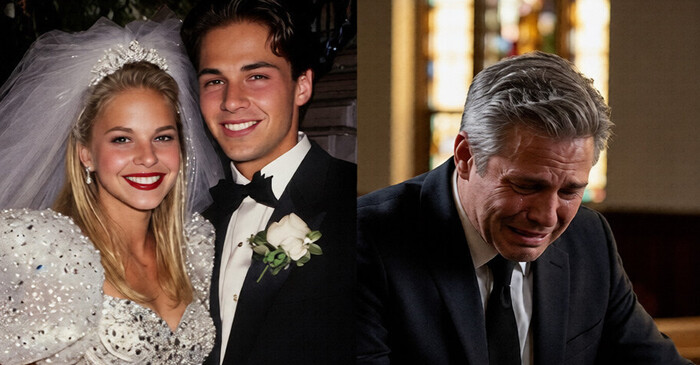
The day my wife Claire died, the house seemed to stop breathing. Sunlight lazily fell on the carpet and her favorite armchair, but there was no warmth in this light—it just didn’t seem to know where to fall.
I stood in the doorway and looked at her chair, as if it could remember her better than me. “Arguments don’t win at the door, James,” she would often grumble, raising an eyebrow at the book. Her voice suddenly came back to my head, sharp, laughing, familiar. I remembered the day when I suggested painting the kitchen beige. “Beige? We are not beige people,” she exclaimed with a theatrical expression on her face. We were partners in everything—in turmoil, in quarrels, in small joys. And now she’s gone.
Her departure was quick and unexpected. The weekend plan in a quiet coastal hotel with a balcony, a cup of tea and a book never took place. Instead, we spent our last days in the hospital, surrounded by white walls and the steady beat of machines. Her body was failing faster and faster, and her voice was getting weaker. On the last night, she squeezed my hand and whispered: “There’s no need to say anything, I already know everything.” I nodded, afraid to cry.
After the funeral, I wandered around the house as if in a dream. Her cup of chamomile tea was left on the bedside table. The glasses are stacked next to the last book you read. It seemed like she’d be back in a minute, but she never came back. Three days later, I decided to find her will. In the closet, I found a small box hidden under winter coats and old photo albums. The duct tape around it was fresh—she must have sealed it recently.
I opened the box in bed, expecting to find a postcard, a note, or something simple and familiar. Instead, the envelope caught my eye first. Inside is a paper with an official seal: the decision on divorce. It had our names and a signed judge on it. The date is twenty—one years ago. I froze. Maybe this is a mistake? But the signatures are real. Mine is crooked and tight, hers is in elegant handwriting. I ran my finger over her name, as if I could rip the answer out of paper.
I was trying to remember: did I divorce her? There was a gap in my head — an accident, after which I spent several weeks in the hospital. Coma, surgery, slow recovery. The doctors said that the memory loss was expected. Claire never said more than what I asked; maybe I just didn’t ask enough. We celebrated our thirtieth anniversary together last year: I gave her a pendant, she gave me a fountain pen with my name on it. We laughed and toasted “for another thirty years.” “We didn’t run away, even when we wanted to,” she said one day, snuggling up to me. But I didn’t know what she meant at the time.
I dug deeper into the box. There was another envelope under the divorce certificate. Inside is a birth certificate: Laila T., born on May 7, 1990. Mother: Claire T. Father: unknown. The date of birth was three years before our wedding. I’ve never heard of Lyle’s name. Suddenly, it turned out that over the years of marriage, Claire had lived an entire chapter of her life alone and hadn’t told me about it.
I sat down on the bed, feeling like the air was draining out of me. Grief, perhaps betrayal, great confusion — all mixed up into one big, heavy sense of loss. Soon there was a knock on the door. It was Claire’s lawyer, Mr. Johnson. He came in with an envelope in his hand, and on his face there was that delicate attention that usually comes from people who bring bad but necessary news.
The envelope contained her handwriting—a letter to me. “My dear James, if you’re reading this, then I’m gone,” the message began. She confessed a secret: Laila is her daughter, whom she gave birth to at the age of twenty and gave to another family to raise. She always thought she had done the right thing, but she never stopped thinking about her. Two years before my accident, she found Lila and came back into her life. Then everything became more complicated. While I was recovering from surgery, their relationship was rekindled, but Claire filed for divorce while I was still recovering. The divorce was formalized, but when I returned home and my memory did not fully return, a new caution arose between us, and the papers remained in the drawer. We continued to wear wedding rings, and life went on as if nothing had happened. She asked me to be lenient: the love between us was never a lie. She wanted me to contact Lila after her death; Claire left a trust for her daughter and gave the number to a lawyer so I could contact her.
I flipped through the letter over and over, my hands shaking. Mr. Johnson placed a card with an address and a number on the table. I held it as if it were the last thread. It took four days before I dialed the specified number. The voice on the other end of the line was wary. “Yes, it’s Laila, who’s speaking?” I said that I knew her mother and that I might be her father. It was awkward and rude to throw it in the face of a young man who wasn’t expecting anything. I tried to soften it up: I’m not saying for sure that I’m the biological father, but there is a possibility along the timeline. I just wanted to get to know you.
We met at a small cafe a week later. When Lila came in, I immediately realized that she had Claire’s walk and features. She sat down across from me, not letting me out of her sight. “Is that you?” she asked shortly. I nodded. The conversation was careful, with pauses, without excessive emotions. She said that Claire called one day and asked how she was doing, but she didn’t give any details. My wife, apparently, did not know how to explain everything. Laila was wary, her voice was dry—she had learned not to put an end to conversations with people who could do harm.
A few days later, over a cup of tea at her house, Laila opened up to me a little more. She worked in adult films—not on a whim, but for the sake of survival. She did not ask for sympathy and did not ask for salvation. “I’m not broken,” she said firmly. “I’m just tired of pretending that everything is fine.” I replied that I had not come to fix her life, but just to be there for her if she wanted to. She offered to do a DNA test, and I agreed. “I’ll stay even if the test shows that I’m not your father,” I said. It was the moment when something started to form between us.
In the following months, we slowly improved our relationship. I helped her find a small apartment: small, but cozy and safe. We chose curtains together, discussed toasters—simple household rituals that seemed to glue us together. I introduced Laila to my children, Pete and Sandra. The meeting was awkward but warm. Sandra immediately hugged her, and Pete, although he asked a lot of questions, tried to show support. Gradually, Laila dissolved into quiet laughter, sincere reactions. One day, sitting on the veranda with hot chocolate and a haphazard conversation, I felt that the grief of losing Claire was still with me, but it had changed — there was a place for life in it, which Claire had already begun to connect with her actions.
Claire seemed to know what she was doing. She kept the secret, perhaps so as not to destroy our new home; but even after her death, she took a step to connect us. The very seam of sadness that stretched through the years became a way to bring those who remained together. It seemed to me that she was leading us to this, even when she couldn’t say a word anymore.
Grief has not disappeared, but it has stopped dominating every day. In the corners of the house, in my daughter’s manners, in the laughter of the children, I saw her over and over again. It’s not the same as having her around, but it was a comfort, the thin thread that Claire used to connect our lives to each other.