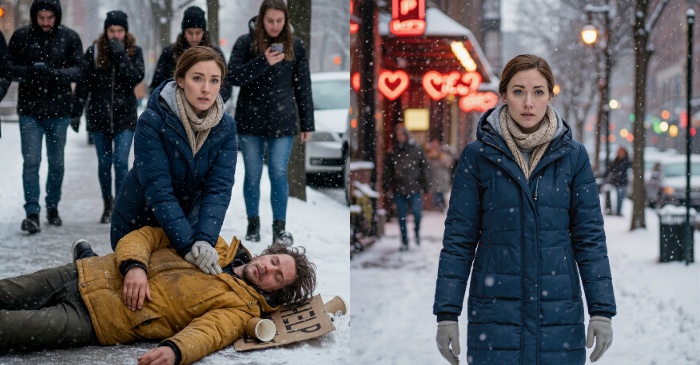
My name is Briar, I am 28 years old. It all happened on Valentine’s Day, and this evening was supposed to be a simple dinner for two. I’m studying to be a paramedic, and I quit my job for the course because it was something I’d been striving for for a long time. My boyfriend Jace convinced me to focus on my studies and promised to support me financially until I got my certificate. He behaved differently that evening, too calmly and aloof. At one point, he stated that he did not want to continue, that he did not see a future. I got up, packed my things, and left—leaving behind four years of relationships and the emptiness of unexpectedly cut-off plans.
The street was full of couples and hearts in the windows; I couldn’t go home, where I had my book and the countdown to the exam. I was walking, and suddenly I heard a wheeze in a narrow alley and saw a man curled up by a container, convulsing. People stood and watched without interfering. I loudly demanded to call an ambulance, then checked on the victim, he did not react, his breathing was shallow, his lips were turning blue. I started doing indirect heart massage, counting out loud, until someone finally called the medics. When the ambulance arrived, I was replaced by professionals; I knew I had done everything I could. Before taking the patient away, he whispered my name and asked me to write it on my wrist with a marker so he wouldn’t forget. I wrote: BRIAR. It almost felt like a symbol.
When I got home, I didn’t expect to see a limo on the doorstep. The same man was standing on the steps, as if the fall in the alley was just a transformation. He introduced himself as Murray, the heir to a large family, explained that he had returned after his parent’s funeral, had been robbed and ended up downstairs. He said that he had money, but no people he could trust, and that he needed someone unbiased‑unimpressed by his status, who would ask questions and notice suspicious details. He offered me a temporary job on the estate: coming to meetings, taking notes, acting as a “contrast” — a person who is not afraid to say that something seems wrong. I set the conditions: I will not drop out of school, everything will be done in writing and I will have the freedom to leave at any time. He agreed.
The estate turned out to be old and luxurious, with staff accustomed to rituals and expedited decisions. At meetings, I observed and asked simple, direct questions about motives and benefits, which often put people in an awkward position and gave Murray a reason to ask again. Meanwhile, Jace tried to text me, but I packed up my things and demanded to return only my own, showing that I did not intend to remain broken. I worked nights at the clinic, studied during the day, and eventually successfully passed the final exam. Sometimes Murray’s driver would give me a ride to class, but Murray never created pressure or flirted out of gratitude—he just provided space.
When it was time to pick up the last of my things, I met Jace at the entrance. He expected to see me broken, but I was calm and confident. The conversation turned into accusations on his part, and I replied briefly that I appreciated his support, but I wouldn’t let him decide for me. I walked past and out into the cold evening, which no longer seemed so cruel. Spring was coming, and for the first time in a long time, I felt like my life was in my own hands. I was proud of myself and my self-control.