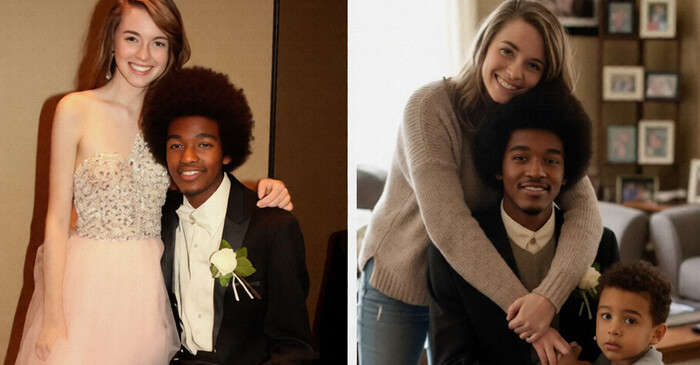
I met him in high school. He was my first love, the kind of person who made teenage life feel like it would last forever. Then, a week before Christmas our world changed — not with fireworks or drama, but with a single phone call that turned everything upside down.
He was supposed to be driving to his grandparents’ that night. That’s the story I believed for fifteen years. I was wrapping presents when his mother’s voice cut through the quiet — frantic, broken. “He won’t get up,” she screamed. “There’s been an accident. He can’t feel his legs.”
The hospital smelled of antiseptic and exhaustion. He lay in a bed surrounded by machines, a neck brace firm around him. His eyes were open; they found mine and held on. Later, the doctor used words like “spinal cord injury” and “paralysis from the waist down.” There was no recovery to promise.
I remember going home numb and telling him, through a blur of fear, “I’m here. I’m not going anywhere.” At the kitchen table, my parents were calm in a way that felt colder than shouting. “Sit,” my mother said. When I told them what happened, her response was immediate and brutal: “This is not what you need. You’re seventeen. You can have a future. Don’t tie yourself to this.”
My dad’s jaw tightened. “You can find someone healthy.” They didn’t try to hide their judgment behind concern. For them it was practical: law school, a career, stability. Love didn’t enter the equation. When I refused to leave him, they gave me a choice — him or us. The next day, my college fund was emptied and the account closed. “If you’re an adult,” my dad said, “be one.”
So I packed a duffel bag. I left the house with my toothbrush and a few clothes and walked toward a life I’d never envisioned. His family lived in a small house that smelled of onions and laundry soap. His mother opened the door, looked at my bag, and simply said, “You’re family.” I cried against her shoulder and settled into a new normal.
We made it work. I went to community college. I took part-time jobs in cafes and shops. I learned how to help him transfer from bed, how to manage catheter care, how to fight insurance companies and hold on to patience when the small things piled up. People stared. Sometimes friends made clumsy jokes. Other times they rallied around us. We went to prom together — he in a wheelchair, me standing between his knees as we swayed under the gym lights. No one from my family came to the wedding; our vows were said in his parents’ backyard with a clearance-rack dress and a Costco cake. We had a son a couple of years later.
For fifteen years I scrolled past my parents’ numbers and pretended their silence didn’t hurt. We had rough stretches — exhaustion, money fights, the logistical toll of caregiving — but we built a life. He finished a degree online, found remote IT work, became the calm, patient person who could explain passwords to his grandmother without breaking a sweat. I believed we were solid. I believed our story was honest.
Then one afternoon I came home early with his favorite takeout and heard another voice in the kitchen. It froze me to my core: my mother’s voice. I hadn’t heard it in fifteen years, but I knew it instantly. She stood at the table, red-faced, waving a stack of documents. He sat pale and shaking in his chair.
“How could you do this to her?” my mother demanded. “How could you lie to my daughter for fifteen years?”
My hands trembled as I accepted the papers. They were printed emails, old messages, even a police report. Dates. Times. A different route than the one I’d been told. My stomach dropped when I saw a name I hadn’t expected: Jenna. Messages from that day showed texts between him and Jenna — flirty, private, ordinary — until the trail ended with the crash.
“Tell me she’s lying,” I begged. He didn’t. He only cried. “Before the accident,” he said with a voice that cracked, “I was leaving her place. I hit the ice. I panicked. I thought if you believed I was an innocent victim, you’d stay. If you knew the truth… you might’ve left.” He told me he’d been scared and ashamed, and that the lie had grown heavy over the years until it felt impossible to confess.
My mother listened, then told me how she’d found out. She’d bumped into Jenna by chance at a grocery store. Jenna had looked worn and told my mother about miscarriages and heartbreak, as if God were punishing her. When my mom asked why, Jenna had told her the truth about that night. My mother had followed the trail, dug up the police report, and come straight to my house.
Everything tilted. I’d given up my family, my plans, my college fund, my future, all because I believed the foundation I’d built our life on was true. He had let me choose him without giving me the facts. For that, my anger was volcanic.
“Where do you expect to go?” he asked, voice small and pleading.
I remembered how, at seventeen, I’d had to figure out where to sleep and how to survive. I laughed once — a sharp, bitter sound. “Exactly what I did when I was seventeen,” I said. “You’ll manage.”
I packed a suitcase — this time not in panic but with resolve. I brought clothes, important papers, and our son’s stuffed dinosaur. I called it a “sleepover” when I picked him up from a friend’s house; he’d never met his grandparents. When we arrived, my parents opened the door and broke down. My father grabbed the doorframe like he needed it to hold him up. My mother cried and apologized — for cutting me off, for staying silent, for never knowing their grandson. It was an apology that could not erase fifteen years, but it was honest.
We hired a lawyer and worked out custody, finances, and a separation. I didn’t want to turn him into my enemy, but I couldn’t continue as his wife. The divorce was messy — the part I hated most — but necessary. I moved into a small apartment, started working full-time, and slowly rebuilt a life on my terms. I told our son a simplified version of the truth: “Dad made a big mistake a long time ago. He lied. Lying breaks trust.” He knows the kid-sized outline; the rest he can learn when he’s older.
I don’t say I regret loving him. I gave everything — my family, my education dreams, my safety net — and I wouldn’t erase those years because they shaped me. But I regret that he never trusted me with the truth. Love without honesty is fragile; fact and trust are the things that make it last.
Now I’m building something new. There’s a slow, tentative truce with my parents that might someday become something more. I work. I parent. I still cry sometimes at night, missing the life I imagined. But I’m learning that choosing love is brave — choosing truth is how you survive.
If there’s one lesson I want anyone to take from this mess of my life, it’s this: being brave for love matters, but honesty is the backbone of any life you build with someone. Without it, everything else can crumble.