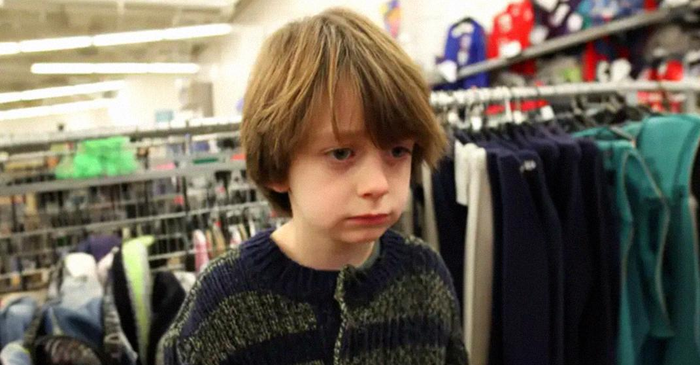
I stood in the middle of Goodwill with a used navy puffer in my hands, fighting back tears. The zipper stuck a little, and it smelled faintly of attic dust, but it was thick and warm — and it was only twenty dollars.
“He doesn’t even have a real coat,” I whispered to Mark, holding the jacket up so he could see our seven-year-old shivering in his thin hoodie. Liam dragged his left leg as he pushed a toy truck along a shelf, the hoodie’s cuffs frayed to threads.
Mark didn’t look. He snatched the jacket from me and shoved it back onto the rack. “Put it back, Sarah. We’re broke. We can’t spend twenty dollars on a coat. Let’s go.” He walked away without another word.
Liam shuffled after him, confused. “Is Daddy mad at me?” he asked.
“No, baby,” I lied, forcing a smile. “Daddy’s just stressed.”
On the drive home, Liam fell asleep with the hoodie bunched around his neck, and my stomach turned over. Twenty dollars stood between my son and a warm winter, and Mark had refused. He’d been distant for months — thinning, tired, short with his answers when I asked where the money went. He checked every receipt, turned down the thermostat until we all wore sweaters inside, and snapped if I bought something small.
There was a padlock on the garage door that hadn’t been there before. Every time I brought it up, he’d say, “Stop worrying. I’ve got it.” But the secrecy made my mind race to the worst possibilities: debt, gambling, another woman. When I pushed him, he’d grab his keys and head into the garage, lock the door behind him, and say he might be late.
After that week at Goodwill, I lay awake, replaying the moment the whole night. The next morning, he kissed my forehead and left as usual, saying he might be late. I couldn’t stand the not-knowing any longer. I went to his nightstand and rifled through the drawer until my fingers found a taped metal key. My hands shook as I took it outside.
Under a heavy tarp in the back corner of the garage sat an old metal lockbox. My heart hammered. The padlock clicked open easily. I pulled off the tarp, pried the latch with a screwdriver, and the box popped open. Inside were papers — and on top, a bank book. I flipped it open. The balance on a recent line made my head swim: thousands of dollars. Enough to cover a used car, enough to buy dozens of coats.
Then I turned the page and my breath stopped. The last full line was a withdrawal slip dated that morning. Balance: $0.00.
I dug further. There was a stack of hospital paperwork. One logo hit me like a punch: Dr. Roberts, Pediatric Orthopedic Surgery. On the patient line was Liam’s name. Procedure: reconstructive surgery. Status: PAID IN FULL. I read it over and over until it blurred.
At the bottom of the box was a small, dog-eared notebook. It wasn’t from his day job — it was a log for a second gig. Night shift: warehouse. 10:00 p.m.–4:00 a.m. There were months of entries. Short lists and numbers in Mark’s handwriting: “Coat for me: no. Liam’s coat: wait. Lunch: $0 (skip). Coffee: $0 (home). Gas: walk to second job.” He’d calculated every penny, walked instead of driving, worked through exhaustion, skipped meals — all to pay for Liam’s operation.
I dropped to my knees on the cold concrete and the notebook slipped from my fingers. Tears fell on the page. I felt a sound tear out of me — half sob, half gasp. That’s when Mark stepped into the garage doorway. Snow dusted his boots; he was wearing a high-visibility vest I’d never seen before. He looked smaller than he used to — hollowed by months of worry.
“I found the key,” I said, voice breaking. “I thought — I don’t know what I thought.”
He didn’t yell. He just looked tired, the kind of tired that sits in your bones. “I was trying to surprise you,” he said. “I was going to tell you when it was final.” He told me he’d paid the last bit that morning after getting a call on his break that Dr. Roberts had squeezed Liam onto the schedule. He’d worked nights at a warehouse for six months, taking whatever shifts he could to cover the surgery. He’d refused the coat because they were twenty dollars short — exactly twenty — and if he’d let me buy it, they’d have missed the deadline and lost the slot.
My anger stalled into shame. I’d called him cruel in my head, accused him of hiding things, suspected the worst. Instead, he’d been carrying the weight of something we both wanted more than anything: the chance for our son to walk and run without that sharp pain in his leg.
“I wanted to fix it,” he said quietly. “I thought if I promised instead of hope, it would hurt less if it fell through. I thought I could be the one who saved it.”
I read the notebook again. “You walked?” I asked, recalling entries that said “Gas: walk to second job.” He shrugged. “It wasn’t far. It saved money.” He’d skipped lunches, gone without, and come home exhausted — not hiding money from us, but protecting us from a hope that might crumble.
We sat on the cold garage floor and cried. I told him I should’ve trusted him. He said he knew he’d been a coward to keep it from me. We both held the truth like a fragile thing, then stood up and went inside.
On the front porch sat a cardboard box half-buried in snow. We opened it to find neatly folded kids’ winter clothes: scarves, mittens, boots — and on top, a brand-new dark green parka with the tags still attached. A note taped to the top read, “I saw you at the store the other day. My son outgrew these. I hope Liam can use them. Stay warm. — Brenda.”
I remembered the woman in the next aisle at Goodwill, watching quietly. Mark let out a shaky breath. “Looks like he got a coat after all,” he said, managing a small, exhausted smile.
We brought the box into Liam’s room. He was on the floor with his toys, his leg stretched out in front of him. “Hey, buddy,” Mark said. “Someone dropped off a surprise.” His eyes widened at the parka. “Is that for me?” he asked.
“Yes,” we said. “Try it on.” He zipped the coat up; the sleeves were a little long, but he beamed. “It’s so warm,” he said. “Do I look cool?”
“You look super cool,” Mark told him. “Like you’re ready for a snow mission.”
Then we told him the news. “The doctor called,” I said. “He’s going to help your leg soon.”
“Will it hurt?” he asked.
“A little at first,” Mark answered, “but we’ll be with you the whole time. After, you might not hurt when you run.”
“Will I be able to race Eli at recess?” he asked, bright-eyed.
“That’s the plan,” we said. “Be brave.” He nodded, then crawled in between us that night. We let him sleep in the middle; his new parka lay at the foot of the bed like a little promise.
Six months of anger melted away, replaced by the knowledge of what Mark had been doing in silence — every skipped meal and every long night in a freezing warehouse had been for our son. He should have told me. I should have asked better questions and trusted him more. Still, knowing now that he’d been working himself to the bone to secure Liam’s operation changed everything.
Sometimes the silence you mistake for selfishness is someone holding on by a thread. Sometimes love looks like worn-out shoes, skipped lunches, and saying “no” to a small comfort so you can say “yes” to the thing that can change a life. The hero of our story wasn’t loud or dramatic — he was exhausted, scared, and quietly carrying us forward.