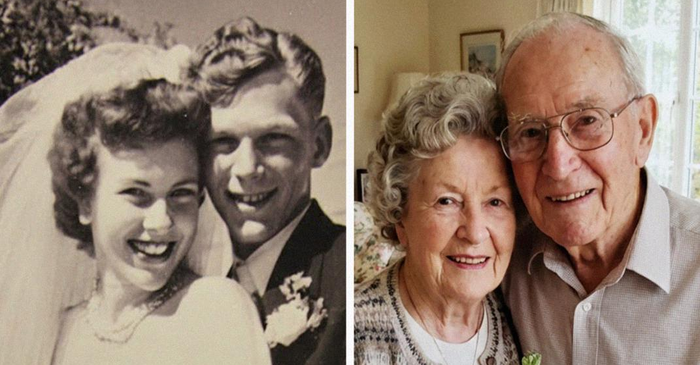
My name is Daisy. I’m eighty-three, and four months ago my husband, Robert, died. He had proposed to me on Valentine’s Day back in 1962 in our college dormitory — a small bunch of roses wrapped in newsprint and a cheap silver ring bought with two weeks’ worth of dishwashing wages. From that day on, he never missed Valentine’s Day.
Sometimes the bouquet was a handful of roadside flowers when money was tight. Sometimes it was long-stemmed roses to mark a promotion. Once, in the year we lost our second child, he brought me daisies, and I remember sobbing into his chest as if the flowers themselves could wash away the pain. Those blooms were more than tokens; they were proof that after every fight, every worry, every hard season, he would come back.
When he died suddenly in the fall — a heart attack, the doctor said quickly, with no suffering — the house felt strangely loud with silence. His slippers were by the bed, his mug on its hook. For months I made tea for two out of habit, then remembered. I talked to his photograph most mornings, told him about the grandchildren, about the leaking sink, about nothing and everything.
Valentine’s Day arrived for the first time without him. I lay in bed for a long time, staring at the ceiling. Later I made tea, sat at the kitchen table, and felt the emptiness of the chair opposite me. Then came a sharp knock. I answered and no one was there — only a bouquet of fresh roses on the mat and an envelope. My hands trembled as I picked them up.
Inside the envelope was a letter in Robert’s handwriting and a small key. The letter began, “My love, if you are reading this, I am gone.” At the bottom of the page was an address, in a part of town I had rarely, if ever, visited. My chest tightened. For years I had wondered about the business trips, the late-night calls he’d taken outside. Once I had asked him if he was hiding something. He kissed my brow and told me there was nothing to worry about.
I hired a taxi and drove across the city, squeezing the key and the letter in my pocket. The building that met me was an old brick structure with a green door. For a long moment I considered turning back. Instead I unlocked the door and stepped into a narrow corridor. The smell that reached me — polished wood, old paper, the faint dust of a music room — was so familiar I felt a pull in my chest.
In the center of the space stood an upright piano, dark and glossy. Shelves lined the walls, crowded with sheet music, recordings, and books on theory. On the bench and stand lay pieces I once loved: Debussy’s “Clair de Lune,” Beethoven’s “Moonlight Sonata.” On a small side table I found labeled tapes and discs, dates stretching back years. Each one read, “For Daisy,” with notes and dates — December 2018, March 2020, and more.
Tucked beneath those recordings were medical reports: a diagnosis, a prognosis, a timeline. He had known his heart was failing. Beside them a contract showed instructions for a caretaker to deliver the roses and the envelope to me on the first Valentine’s Day after his passing. He had planned all of this.
There was also a journal. The earliest entries were ordinary domestic notes until one caught my eye: “Daisy mentioned she used to play the piano. She said she dreamed of concerts once, but life pulled her away. She smiled, and I saw a sadness.” I remembered that afternoon, flipped through my old sheet music and laughed it off. Robert hadn’t forgotten.
The following entries were a record of his secret: he had taken piano lessons, clumsy and stubborn, practicing scales in the evenings; he had recorded himself playing; he had hired the studio and gathered the scores. “I want to give her back the dream she gave up for our family,” he wrote. There were honest entries about frustration and aching fingers, about learning slowly, about playing “Clair de Lune” for the first time so it would be there for me.
Near the end, the pages grew shorter. “Doctor says the heart is failing. I don’t have much time. I’m writing a piece for her. If I can finish it, she will know.” The final note, written a week before he died, said simply, “I’m out of time. I’m sorry.”
On the piano’s stand I found a half-finished composition in his careful script titled “For My Daisy.” The music was beautiful and intricate, but it stopped midway across the second page. My fingers hovered, then settled. Dust motes floated in the sun. I sat and began to play what he had written. At first my hands felt foreign, unused. Then muscle memory — tucked away for six decades — returned. Where his ink ended, my hands kept going. I followed the piece’s spirit, found resolutions he had left unwritten, and finished what he had started.
After I played the last chord, I noticed a small envelope tucked behind the stand. Inside, his last letter to me read: “This piano is yours now. Play again, my love. Know that I am in every note and every song. I loved you at twenty and I love you still. Always yours, Robert.” I folded that note and kept it in my pocket like a talisman.
I come to the studio twice a week now. Sometimes I practice, sometimes I sit and listen to the recordings he left. My daughter came once and cried when she heard him play. Last week I recorded my first piece in sixty years, imperfect and slow, but finished. I labeled it “For Robert” and placed the disc on the shelf beside his.
For sixty-three years he brought me flowers. After he died, he brought me back to the music I’d set aside and gave me a key to a room where, in the silence, he taught me that some gifts arrive on time only after a goodbye. I still miss him every day. But here, among the notes and the piano’s familiar weight beneath my hands, we are together in the way that lasts.