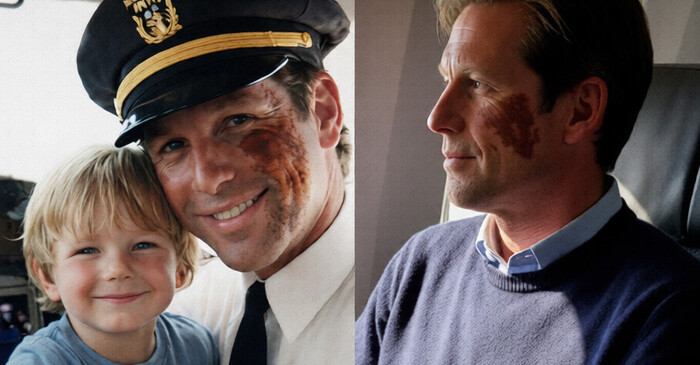
I’ve loved the sky for as long as I can remember. When I was a child in the orphanage they showed me a faded photo that became my compass: me, grinning in a small cockpit, and a man in a pilot’s cap with a large dark birthmark across one side of his face. For twenty years I convinced myself he was my father.
That picture was everything. Whenever I stumbled in flight school, ran out of money, or failed an exam, I’d pull that photo from my wallet and study it like a map. People told me I didn’t have the background or resources to succeed in aviation, but the photograph was my proof that I belonged in the cockpit.
At twenty-seven, I finally sat in a commercial jet’s captain seat for the first time. My co-pilot, Mark, teased me about nerves as we lined up for takeoff. I kept my hand over the photo in my pocket and told him childhood dreams can come true. The takeoff went smoothly, and once we’d reached cruising altitude I felt the familiar calm that comes with being above the world. For a moment the years of searching and longing didn’t feel necessary — I was where I’d always strived to be.
A few hours later a loud thump from first class snapped me back to the cabin. One of the flight attendants, Sarah, barged into the cockpit, pale and frantic: a passenger was choking. Mark stayed at the controls and I ran forward. Training and first-aid drills took over without hesitation — I knew what to do.
He was on the aisle floor, clawing at his throat. I cleared the surrounding passengers away and got behind him to perform the Heimlich maneuver. That’s when I saw the birthmark. For a beat my mind froze, but I pushed the shock aside and worked until a small hard object flew from his mouth and the man gasped in air. The cabin erupted in relief and applause. I barely registered the noise; I only saw his face.
The word I’d rehearsed for years slipped out before I could stop it. “Dad?” I whispered.
He looked from my uniform to my face and shook his head. “No. I’m not your father,” he said. Then, as if a different part of him had been waiting to speak, he added quietly, “But I know who you are. That’s why I took this flight.”
My name was on my jacket, but something in the way he said it made the moment feel heavier. He told me to sit beside him and began to tell his story. He and my father had been flying partners years ago — cargo and charters — practically brothers. He admitted he knew what happened to my parents and knew I’d ended up in foster care. The question I’d carried for decades came out before I could weigh it: why didn’t he come for me?
His answer was blunt and simple: he flew because flying was everything, and his life had no roots. He took long contracts abroad and couldn’t offer the steady presence a child needed. “It would have been kinder to leave you,” he said. The words cut deeper than I expected.
When I asked why he’d sought me now, he said his flying days were over — he’d been grounded the previous year for failing eyesight. He’d wanted to see who I’d become. I pulled the old photograph from my pocket and held it up between us. He studied it, and for a moment it seemed like recognition softened him.
“It did something,” he said haltingly. “You became a pilot because of me.” The sentence landed oddly. I’d built a life on that picture, but I hadn’t built it because of him — I’d done the work. I became a pilot by choosing the hard path: studying, failing, persisting.
He made a small, vulnerable request: to sit in the cockpit one last time. He wanted to feel the seat again. My first instinct was to be polite, to accommodate the man who’d been a face in a photograph — but then I realized I didn’t owe him anything. I’d searched for years for a missing link, hoping it would explain everything. Meeting him didn’t bring clarity; it brought a different truth.
I told him that the photograph had been a seed, that it gave me a dream to aim for, but that I was the one who watered it. “You don’t get to take credit for my life,” I said. I offered him the photo, set it on his tray, and told him to keep it. I couldn’t let the man in the picture rewrite the story I’d written for myself.
Back in the cockpit, Mark glanced over as I settled back into my seat. He asked if everything was all right. I tightened my hands on the controls and looked at the horizon. The engines’ steady hum felt like confirmation — I hadn’t inherited this life; I’d earned it. “Everything’s clear now,” I told him.